PiEEG, a Scotland-based brain-computer interface (BCI) startup, announced it’s launching a facial interface for Quest headsets that aims to turn your brain signals and facial micro-expressions into real-time avatar control.
PiEEG has specialized in BCI since it was founded by Dr. Ildar Rakhmatulin in 2022, specifically to provide low-cost solutions for researchers, developers and hobbyists. Now the company says it’s getting ready to launch a Kickstarter soon for its PiEEG XR, a neural facial interface for Quest.
The device, which includes built-in electroencephalography (EEG) sensors, is of course targeting developers and researchers hoping to integrate EEG data into XR applications, although it’s also slated to arrive with native VRChat integration, letting users “control [avatars] directly from your brain and facial expressions,” the company says.
Notably, EEG sensors measure electrical activity generated by the brain. However, consumer EEG systems generally don’t “decode” specific thoughts. Instead, they can detect broad signals associated with states such as attention, relaxation, or cognitive workload, which can then be mapped to software actions.
That said, the company maintains its sensor-studded facial interface for Quest will enable more expressive avatars and additional hands-free input methods, which can be translated into various effects, modifying environments, or altering avatar animations based on attention-related signals using its ‘Focus-to-Action’ API.
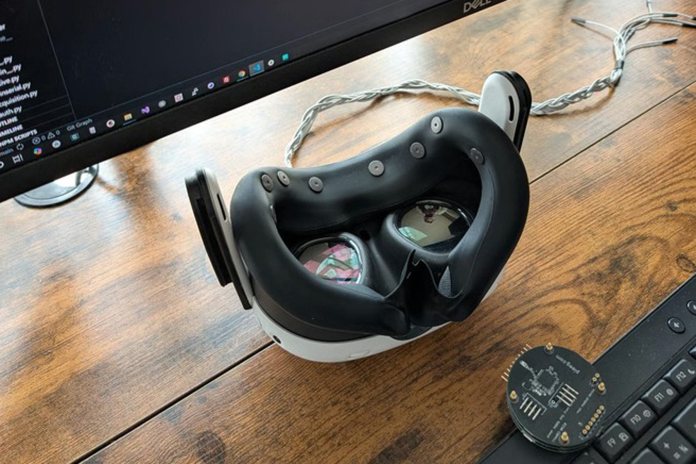
And like its other BCI hardware, the company says PiEEG XR is set to be fully open-source, providing access to software tools and raw data streams for developers, educators, and researchers.
“Whether you are a developer looking to build ‘thought-controlled’ horror games, or a researcher studying emotional responses in VR, the VR-Link provides the raw data and tools you need to innovate,” PiEEG says.
The EEG facial interface itself is powered by the company’s IronBCI platform, which includes 24-bit resolution, 250 samples per second acquisition rate, Bluetooth Low Energy 5 (BLE 5) connectivity, and low-noise signal acquisition.
We’re hoping to learn more soon about pricing tiers and more use cases when the campaign goes live, which is expected soon. In the meantime, you can check out the Kickstarter here and sign up for launch notifications. You can also see a short demo of PiEEG XR below, showing an avatar animated via EEG signals.
This article was originally published on roadtovr.com